Payment by Bill
Make payments by bill
Record payments to suppliers against the specific purchase bills they settle. One payment document can pay many bills of one supplier, by cheque from your Cheque Book, by other modes (NEFT, credit notes, discounts) or a mix of both.
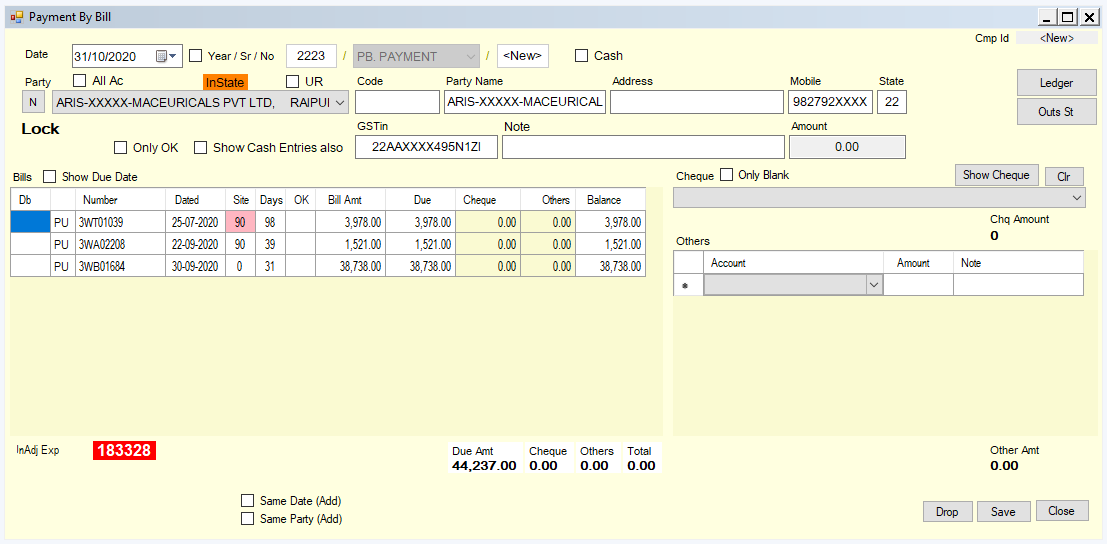
The screen follows the usual Transaction Screen pattern: it opens showing the last payment; use Add New, Edit, Delete, First / Previous / Next / Last, or the series and number with Find. Add New needs a document series selected beside Find (it is chosen automatically if there is only one).
The entry screen has three parts:
- Bills Section - the supplier's unpaid bills, with the amounts being paid.
- Cheque Section - the cheque used for the payment.
- Others Section - the accounts adjusted when part of the payment is not by cheque.
Steps
-
Click
Add New. Set the Pay Date. -
Select the Party (supplier). Only creditor-type accounts are listed; tick All Ac to list every account.
Nbeside it adds a new account. The supplier's details are filled in, and the Outs St and Ledger buttons show the supplier's outstanding statement and ledger. If the supplier has expiry credit that has not been adjusted against any bill, UnAdj Exp shows its value in red. -
In the Bills Section, dsGST lists the supplier's unpaid purchase bills (oldest first) with the bill date, number, due date (tick Due Date to show it), age in days, whether the bill has been marked OK in purchase entry, the bill amount, the amount Due, and a Balance column.
- Tick Only OK to list only bills that have been marked OK / done.
- Cash purchases are hidden unless Show Cash Entries also is ticked.
- Tick Ent Amt or Note to add the entry-amount or bill-note columns.
-
For each bill you are paying, type the amount in
- Cheque – to be paid by the cheque selected below, or
- Others – to be settled through the Others Section (NEFT, credit note, discount etc.).
The Balance is recalculated as Due − Cheque − Others. To pay several bills in full at once, select their Balance cells and click Chq or Oth beside the grid; each selected balance is moved into the Cheque or Others column.
-
In the Cheque Section, pick the Cheque from the cheque book. The list shows unused, uncancelled, unstopped cheques that are either unallotted or already allotted to this party. The cheque amount is set to the Cheque total of the bills. Chq Date is the date written on the cheque — leave it unticked and it is the same as the Pay Date. Clr removes the choice and Show Cheque opens the cheque.
-
In the Others Section, add a row for each account to be adjusted — choose the Account, the Amount and a Note. If the Others column of the bills is more than what you have put in the section, click Adjust to spread the shortfall over the bills that still have a balance.
-
Add a Note if you want one, and click Save.
Save Button
The Save button is enabled only if
- a party is selected and the Pay Date is valid for the financial year,
- the Cheque total of the bills equals the Cheque amount (any difference is shown in a box in the Cheque Section), and
- the Others total of the bills equals the total of the Others Section (any difference is shown as
Disc).
Saving with nothing entered discards the document. If the document already existed, it is deleted.
Editing and deleting
Open the payment and click Edit or Delete. They are not offered if the bill is marked Done, if the cheque is already cleared, or if the payment has been reconciled with a bank statement or locked (the Recon / Lock tags are shown). Deleting also frees the cheque, which can then be used again. Force is shown to permitted users when another user has the payment locked.
Print and e-mail
Print produces the payment advice for the supplier (tick Preview to see it first) and EMail sends it to the supplier's address in the account master.
List of Payments by Bill
Detailed list of payments by bill with particulars of bills paid and payments.
This will give a list of party with the amount paid.